
22 July 2026
Call Me MOTHER: Gouais Blanc
I was sitting in my aunt and uncle’s pub in Geelong, The Telegraph Hotel, at a special event organised by the Barwon Food & Wine Society. I’d never been to one of their events before but was cordially invited along to at
I was sitting in my aunt and uncle’s pub in Geelong, The Telegraph Hotel, at a special event organised by the Barwon Food & Wine Society. I’d never been to one of their events before but was cordially invited along to attend by my relos (they know I’m hella into wine obvs).
A few wines were poured throughout the evening, all done blind. The wines were revealed at the end of the dinner, old Cabernet here some white Burgundy there, a Sauternes. At the beginning, a traditional method/charmant sparkling of some sort. The guests at my table took their glasses to their noses, “surely a Cremant of some sorts”, “not autolytic enough for Champagne”. From what I recall about the wine it was simple, citrus-driven, very faintly toasty, refined, but didn’t have a voice that I recognised.
What the entire room didn’t know was that this sparkling was only one of a few commercially bottled wines of its kind in the world.
This wine was revealed last, as it brought the most allure. The wine in question was Chambers Rosewood Vineyard Sparkling Gouais Blanc. It had a bit of bottle age on it from what I recall. It retails at around $40.
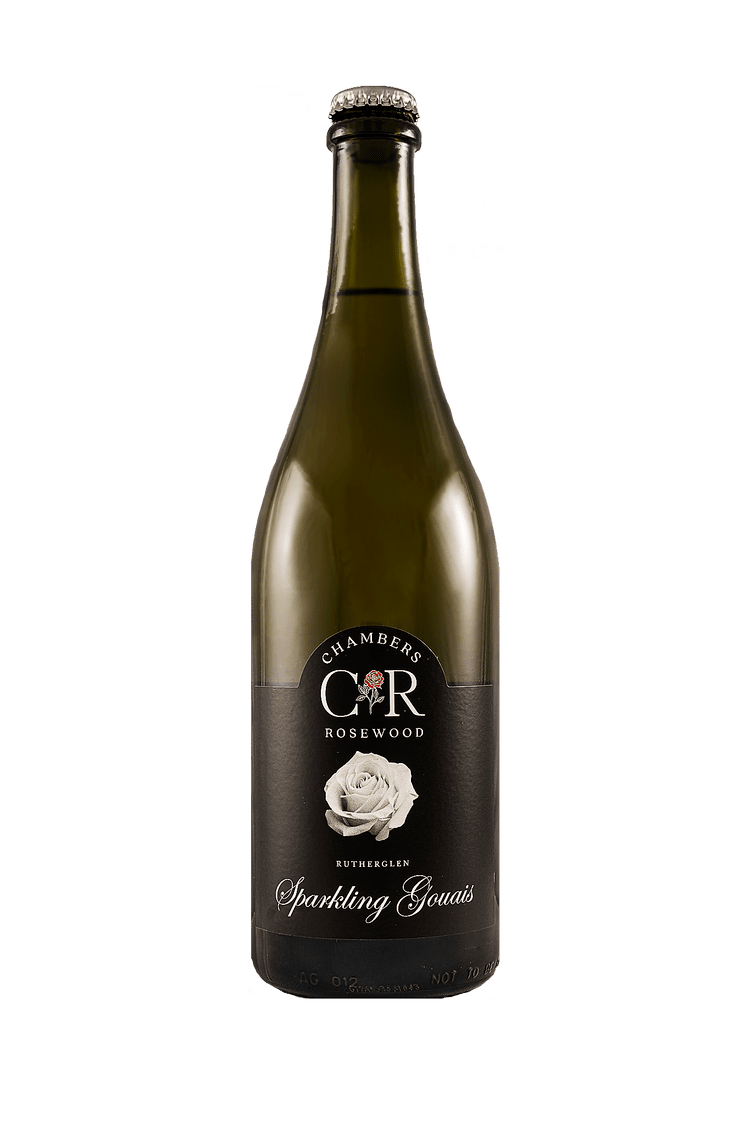
For those of you wondering what the fuck that all means, this has two elements to the story. The first part are the colonial artefacts that are old European grape vines established in Australia long ago due to a man named James Busby. He is the sole reason wine production proliferated in Australia and continues to exists today, and that an obscure grape like Gouais Blanc could end up in the antipodes.
Essentially vine cuttings brought by him from predominantly France and Spain went on to be dispersed and propagated by settlers. Some of these families are still producing wine today and are what’s known as ‘Australia’s First Families of Wine’.
While Chambers of Rutherglen is not included in this band of families, they are still are family run vineyard with vine material exceeding 100 years old and are funnily enough most well-known for their fortified wines, which, even more interestingly is a style of wine unique to Australia called Muscat. Yep, that deeply luscious brown stuff that resembles toffee and lunchbox sultanas and dates.
I digress.
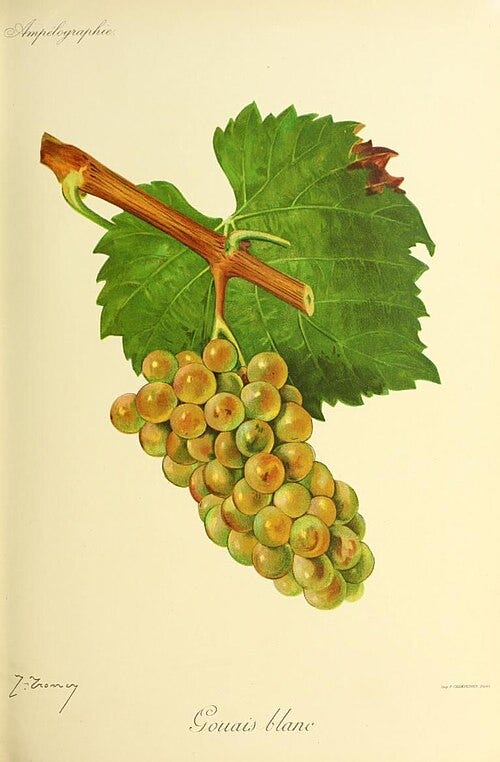
The other element to this is the grape variety in question, Gouais Blanc. Who is she?
To start, grapes are ancient fruit-bearing vines that have been bred and cultivated by humans for time immemorial. Just like how the humble cabbage is the O.G of the brassica family and has been bred to produce kale, broccoli, brussel sprouts, kohlrabi and cauliflower, grapes have been treated much the same to produce specific traits down to colour (anthocyanin), skin thickness, berry size, bunch sizes, hardiness (drought tolerance), aromas and even ripening times.

Grapes set themselves apart from brassicas in the they mutate and crossbreed with little effort. Take the world’s most widely planted wine grape, Cabernet Sauvignon. It’s kind of wistful to think hundreds of years ago in a vineyard or even in some random garden of a chateau in the south of France that Cabernet Franc and Sauvignon Blanc grew a bit too close to one another and well… cross-bred! Sounds a bit naughty actually.
The origin of Gouais Blanc is obscure as much as it is hilarious. It’s considered to be a leading progenitor (common ancestor) grape in western Europe. She is OLD! Like, Roman times old. Because of this you get at ludicrous name variations like Gau, Geauche, Goe, Goet, Goi, Goin, Goix, Got, Gouay, Gouche, Gouest, Geauche and so on as it was dispersed slowly but surely around Europe. Then there’s the Germanic name of the same grape Heunisch, which looks like Heinisch, Heinsch, Heinschen, Hennische, Hensch, Heunsch, Hinschen, Hintsch, Heunsch,Huntsch, Hyntsch depending what century and where you are. These are just a few of many, many more synonyms.
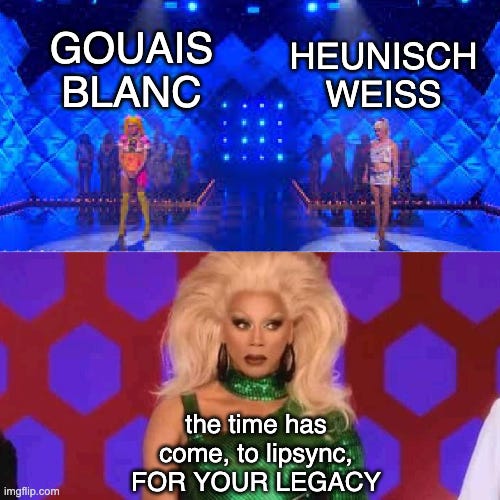
Even more comically Gouais was described in 1539 as thus, ‘the big large Hynsch grapes, which are known for their rapid growth, are called shit grapes by some’.
Whatever Gouais’ pedigree —achem’..shitty, vigorous fuckchild— it was certainly active in the cross-breeding department throughout the middle ages being the parent of at least 81 grape varieties across Europe. Gouais and the much-admired Pinot gave us hard-hitters like Chardonnay and Gamay. Gouais and the highly-favoured Traminer (Savagnin) gave us Aubin Blanc and Petit Meslier. (Petit Meslier, funnily enough, is also vinified into a sparkling rosé here in the Barossa, shoutout to Jo Irvine at Levrier wines). Heck, Gouais even crossed with an unknown parent that gave us icons like Furmint, Blaüfrankisch and Riesling. Well yes, you could say the much adored Riesling is a bastard-child. These are just a few!!
While the origin story of the Gouais vine is uncertain it is generally nailed down to French progeny, which is just so fitting given the affiliation of the French and romance.
Gouais’ is now a fledging grape in modern-day viticulture mostly due to it being simplistic vinously. A reputation that was recognised as early as 1598 when bans were put in place and the vines removed. ‘Noble’ grapes like Pinot and Savagnin were highly favoured at this time.

Today, Gouais Blanc’s legacy is only alive due to its well-known offspring and they are certainly having more air time than their mother. Sometimes geeked over by ampelographers, at times used anecdotally by the odd sommelier to a guest, the winning point at a wine trivia night.
And so we arrive back at the pub in Geelong. It’s remarkable that this one wine that touched my lips could contain so much narrative, names, so many corners and nooks, so much legacy, and the same time be considered a basic-as-fuck variety that almost ceases to exist.
I revel in quiet delight that I tasted a wine from Rutherglen Australia, made from 1.5 acres of 100 year old Gouais Blanc vines. A grape that went on to create so many legendary children in the wine world (most by accident) propagated with cuttings brought over by some white dude from Europe in the 1800’s. These offspring grapes have now spread to the far reaches of the globe, a fate driven by the colonial machine. They have gone on to produce some of the world’s best and most shittiest wines respectively. Wines that you and I have shared, made memories with, had tears with, laughter with, joy with, abandon with, hedonism with, drunk calls with, sadness with, amazing plates with, ciggies with and everything in between.
ALL HAIL GOUAIS BLANC, MUTHA to many LEGENDARY children of the house of VITIS VINIFERA.
Jordi Yeates (he/him) manages Crooked Drinks, a little wine store on Smith Street in Collingwood on the unceded lands of the Boonwurrung and Wurundjeri Woi Wurrung poeple of the Kulin nation.